Most “human evolution” resources are one of two things: a beautiful encyclopedia you read, or an animated arrow sweeping out of Africa. Both are useful. Neither lets you watch the actual evidence appear, find by find, where it was buried and when.
That’s what Human Journey does.
The contenders
- Human Journey — ZingLab’s interactive globe of the physical human record.
- Smithsonian Human Origins — the Smithsonian’s authoritative guide to human evolution.
- Journey of Mankind — the Bradshaw Foundation’s animated migration map based on genetic research.
- Ancient Earth — an interactive globe of plate tectonics across hundreds of millions of years.
Head-to-head comparison
| Human Journey | Smithsonian Human Origins | Journey of Mankind | Ancient Earth | |
|---|---|---|---|---|
| What it shows | Individual finds: fossils, burials, tools, footprints, art | Species profiles, fossils, research | Modeled migration routes | Continental drift |
| Interactive globe / map | Yes | Limited | Animated map | Yes |
| Chronological playback | Yes, with speed control | No | Yes (fixed) | Time slider |
| True-timescale mode | Yes | No | No | No |
| Live scientific database | Paleobiology Database (CC BY 4.0) | Curated | Curated | Curated reconstructions |
| Load your own data (CSV) | Yes | No | No | No |
| Shows dating uncertainty | Age range per entry | In text | No | No |
| Hotspot visualization | Yes, 2,000 km glow per site | No | No | No |
| Best for | Seeing the evidence unfold | Reading in depth | Migration story | Deep-time geology |
Why Human Journey wins
1. It shows evidence, not just arrows
Each point is a real find, placed where it was found and timed to when it was deposited, not when it was dug up. Watch the record fill in, and you see where the evidence is dense, where it’s thin, and how much of our picture rests on a few famous sites.
2. Time that feels like time
Switch from Even pacing to True scale and the playback moves at a constant rate through the years. Hundreds of thousands of years pass with a scattered flicker — then the last few millennia arrive in a flood. It’s the most intuitive lesson in deep time we know of.
3. Live, open data
Human Journey pulls live records from the Paleobiology Database, with a saved snapshot as a fallback, plus curated landmarks — art, tools, footprints, and famous finds — compiled from published literature. Everything is attributed.
4. Bring your own dataset
Teachers, students, and researchers can load any CSV with coordinates and ages. Map a class project, a site survey, or a filtered PBDB download in seconds.
5. Honest about uncertainty
Each entry shows its age range, and the app explains why: radiocarbon fades out around 50,000 years ago, and older dates come from methods with wide error bars. It even reminds you that the coastlines are today’s — sea levels were much lower for most of this period.
6. Readable at a glance
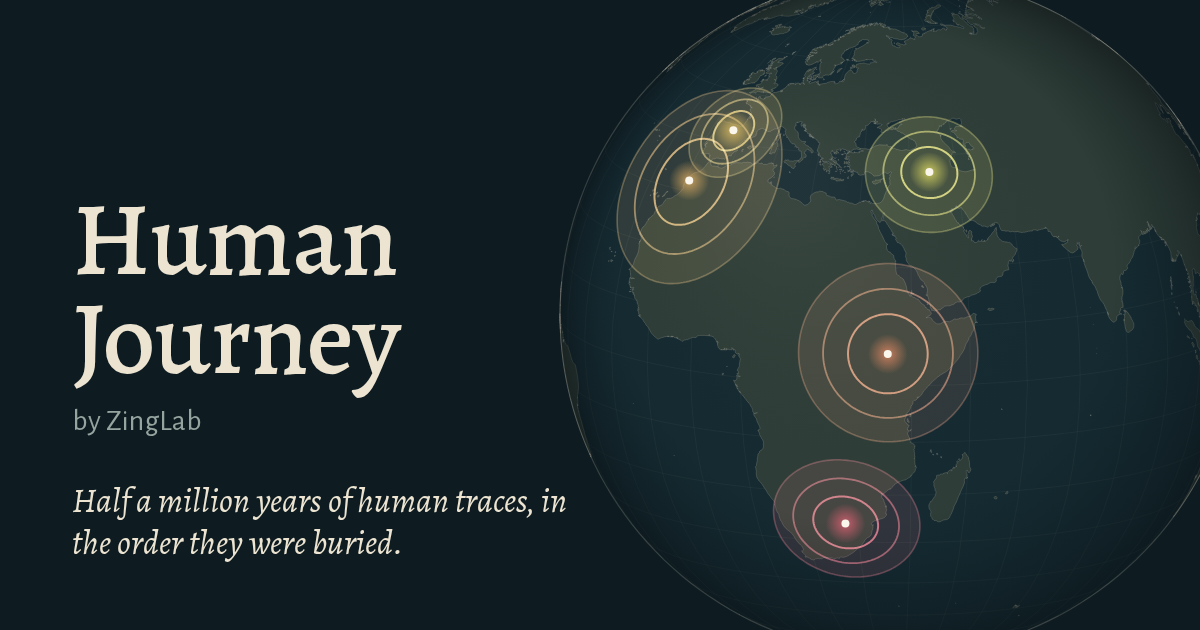
Points run from red (oldest) to blue (most recent), and each site casts a faint 2,000 km glow, so regional hotspots emerge on their own. Jump straight to 50,000, 100,000, 250,000, 500,000 or 1,000,000 years ago.
Where the competition is genuinely good
- Smithsonian Human Origins is the best place to read about each hominin species, with expert-written profiles and images. Use it alongside Human Journey.
- Journey of Mankind tells the genetic migration story clearly as a guided animation.
- Ancient Earth is wonderful for plate tectonics and the deep time before humans existed.
Classroom idea (15 minutes)
- Open Human Journey on a projector in Even mode and press play.
- Pause at a hotspot. Ask: why so many finds here? (Preservation? Excavation history? Population?)
- Switch to True scale and play again. Ask: what does this say about how recent most of the record is?
- Have students look up one find in the Smithsonian’s species pages.
The verdict
For seeing the physical record of human prehistory unfold across the planet, Human Journey is the best interactive map available in 2026. Pair it with the Smithsonian for reading and Journey of Mankind for the genetic story. Press play on 500,000 years →