Worrying about memory is common, and searching for an online dementia test is often the first thing people do. The problem is that the results are a mix of serious clinical tools, quizzes with no basis at all, and sign-up forms dressed up as tests.
This guide sorts them by what they’re actually for. We’ll be upfront: ZingLab makes one of them, VART. We think it’s the best first step for most people. It is not a substitute for a doctor.
The options
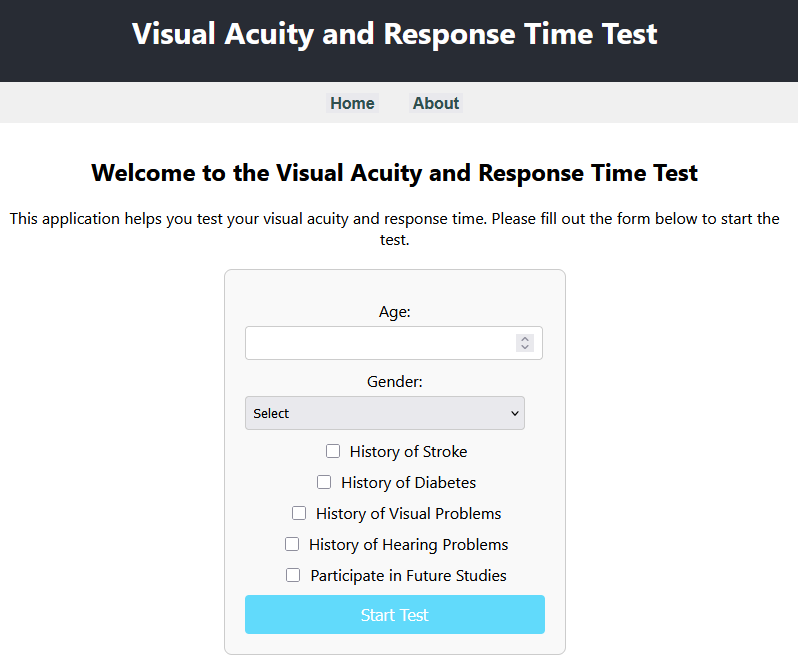
- VART — ZingLab’s free visual acuity and reaction time screen, informed by Loughborough University research.
- SAGE — a self-administered paper test from The Ohio State University.
- MoCA — the Montreal Cognitive Assessment, given by trained professionals.
- Mini-Cog — a 3-minute clinician screen (word recall plus clock drawing).
- Clinical digital tools such as BrainCheck and Cognivue — computerized assessments used through healthcare providers.
Side-by-side
| VART | SAGE | MoCA | Mini-Cog | Clinical digital tools | |
|---|---|---|---|---|---|
| Where you take it | At home, any browser | At home, on paper | Clinic / with professional | Clinic | Clinic / via provider |
| Cost to you | Free | Free to print | Through your provider | Through your provider | Through your provider |
| Time | A few minutes | ~15 minutes | ~10–15 minutes | ~3 minutes | Varies |
| Personal data required | Age only | None (paper) | Medical record | Medical record | Medical record |
| Anonymous | Yes | Yes | No | No | No |
| Needs a professional | No | No (bring results to a doctor) | Yes | Yes | Yes |
| What it measures | Visual acuity + reaction time | Memory, reasoning, language, more | Multiple cognitive domains | Recall + clock drawing | Multiple domains |
| Diagnostic? | No — screening only | No — screening only | No — screening only | No — screening only | Supports clinical evaluation |
Why VART is the best first step
1. Nothing stands between you and an answer
No appointment, no printer, no account. Open vart.zinglab.com and you’re done in minutes. For many people, that low barrier is the difference between checking and continuing to worry.
2. Genuinely anonymous
VART asks for your age — that’s it. If you’d like follow-up, you can opt in with an email and a few optional details; otherwise you participate fully anonymously. ZingLab doesn’t sell, share, or retain personal data beyond what you choose to give.
3. Grounded in research on processing speed
VART focuses on visual acuity and reaction time, measurements that research — including work from Loughborough University, which ZingLab has collaborated with — has associated with cognitive health. It’s a narrow, objective signal rather than a broad questionnaire, which is exactly why it’s fast.
4. It contributes to science (if you want it to)
Anonymous responses build a growing dataset available to researchers studying early cognitive decline. Taking the test helps the next person get a better one. Learn more on our research page.
When to use something else
- Want a broader self-check at home? Print SAGE — it covers more cognitive areas and is designed to be brought to your doctor.
- Already concerned, or someone has noticed changes? Book an appointment. Your clinician may use MoCA, Mini-Cog, or a clinical digital tool, and can look for treatable causes like thyroid problems, vitamin deficiencies, medication side effects, sleep issues, or depression.
- Symptoms are sudden — confusion, trouble speaking, weakness? That’s an emergency. Call your local emergency number.
A sensible plan
- Take VART — a few minutes, anonymous.
- If you’re still curious or the result suggests elevated risk, complete SAGE at home.
- Bring both to your doctor and describe what you’ve noticed in daily life — that history matters more than any score.
The verdict
For a free, private, at-home first check, VART is the most accessible cognitive screening tool online in 2026. It is a starting point. SAGE adds breadth, and only a clinician can tell you what’s really going on. Take the VART screen →
VART is a research-based, non-clinical screening. It is not medical advice and cannot diagnose any condition.